
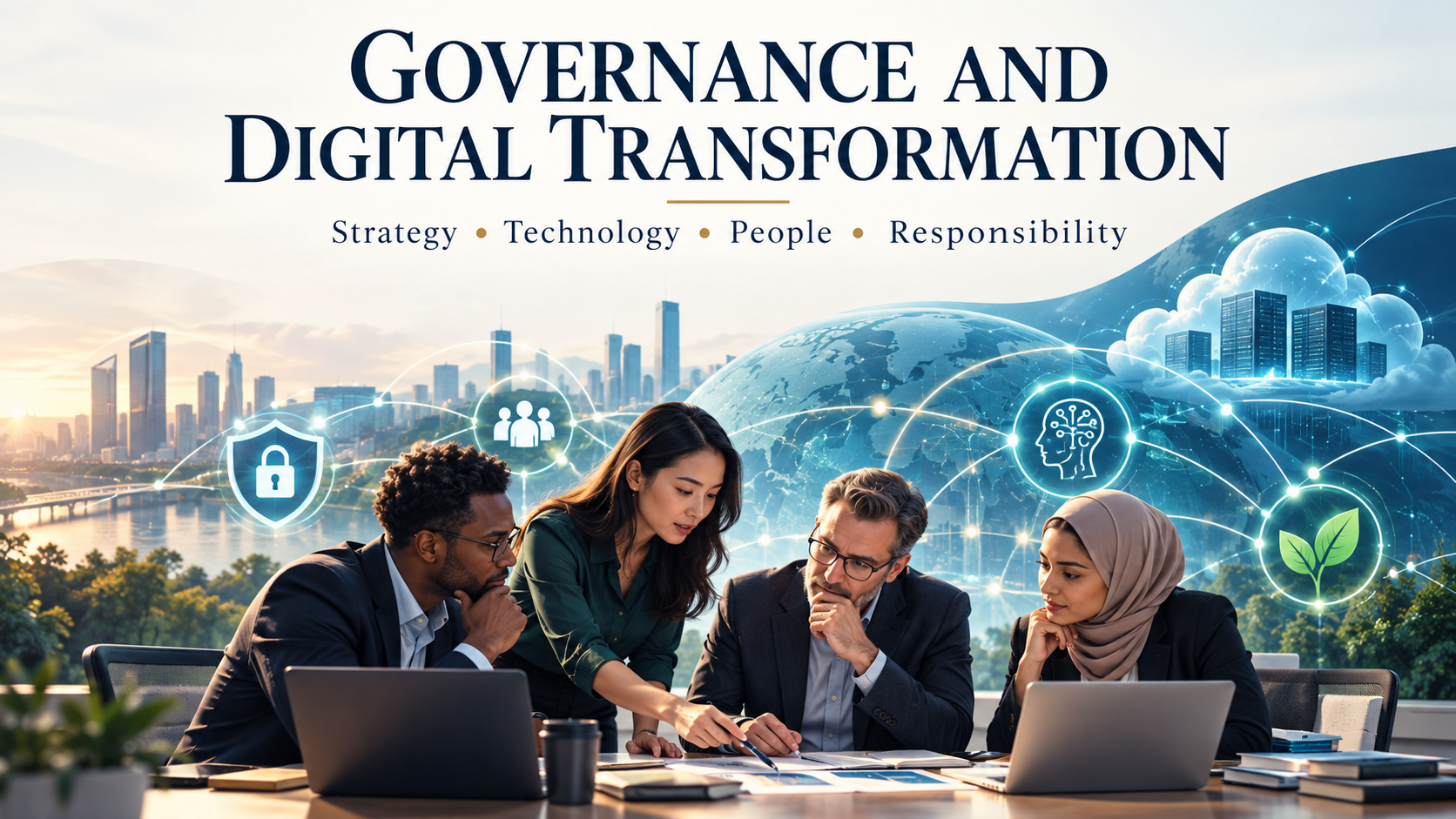
This master’s-level course examines how organizations guide digital transformation through effective governance, strategic alignment, and responsible decision-making. It combines management, law, economics, and computer science to explain the organizational, human, and technological factors that shape digital projects. No prerequisites are required.
The textbook covers five chapters:
- Foundations of corporate governance: Historical origins, agency theory, shareholder and stakeholder approaches, and the transition to digital governance.
- Core concepts: IT governance and management, frameworks such as COBIT, ITIL, and ISO/IEC 38500, digital transformation, digital maturity, and change management.
- Applications in computer science: Enterprise architecture, cloud governance, cost control, data governance, cybersecurity, responsible AI, and personal data protection.
- Case studies: Analysis of transformation initiatives in banking, manufacturing, public administration, healthcare, education, and retail using a structured five-step method.
- Responsible digital technology and sovereignty: A supplementary chapter addressing environmental impacts, digital sobriety, technological dependencies, and control over strategic data.
By the end of the course, students should be able to assess digital maturity, identify governance weaknesses, evaluate risks, and propose practical recommendations for digital transformation.
- المعلم: KHALLADI Rachid