
The TD sessions provide practical exercises and guided activities to apply theoretical concepts of information systems, including system components, information flows, and basic analysis and modeling techniques.
- المعلم: boudia cherifa
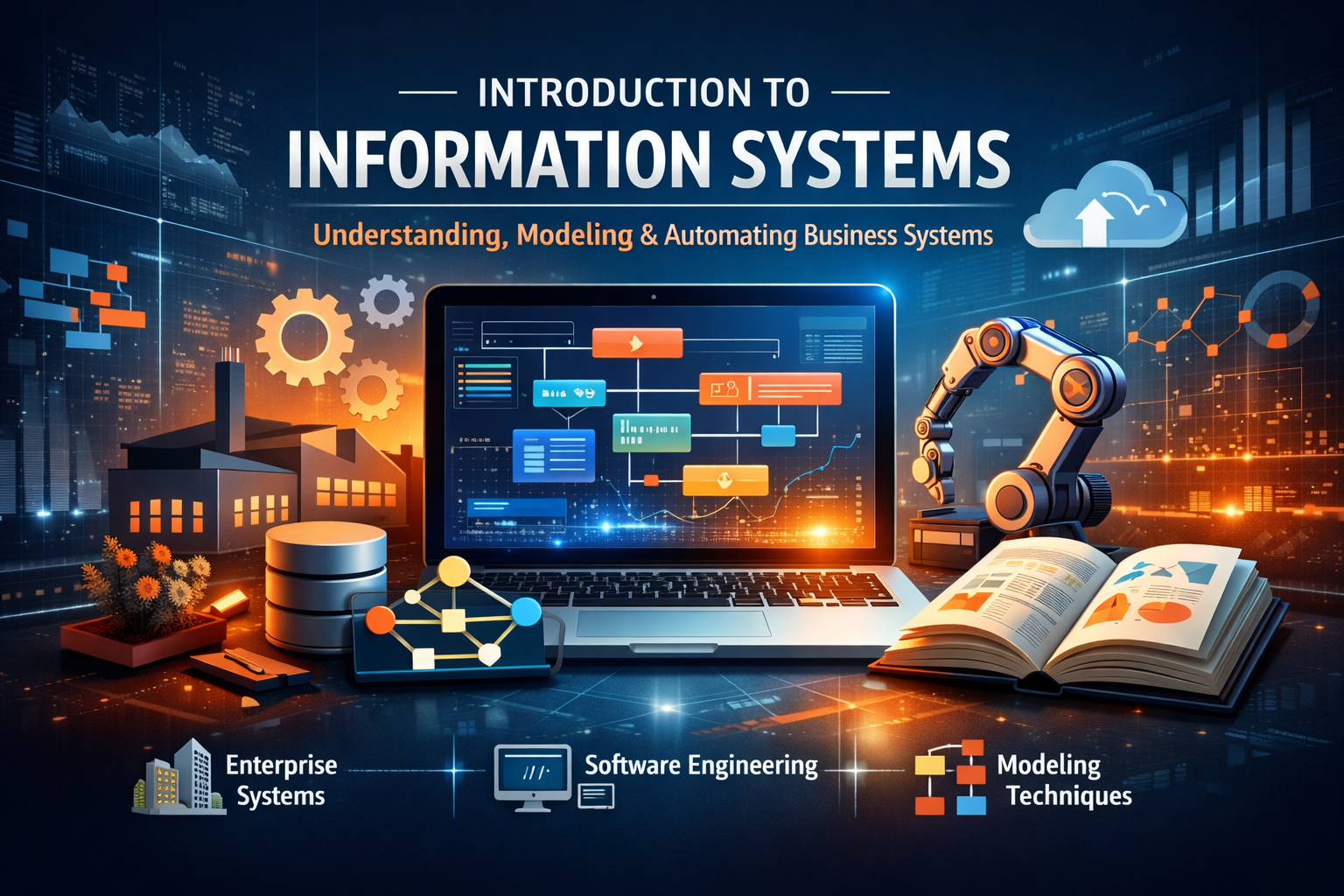
This course provides a comprehensive introduction to Information Systems (IS) within organizations. It covers fundamental concepts of systems and enterprises, the role and importance of information systems in supporting operational activities and managerial decision-making, and the transition from manual to automated systems. The course also introduces software engineering principles and information system development methodologies, with particular emphasis on system modeling techniques such as MERISE and entity–relationship modeling. Through theoretical lectures and practical sessions, students gain the ability to analyze, model, and design information systems that effectively support organizational processes.
- المعلم: boudia cherifa
Course : Probability and Statistics 2
Level : 2nd Years State Engineer in Computer Science
Instructor : Dr. Ahmed Bouchenak (Associate Professor -
Email : a.bouchenak@univ-mascara.dz
Teaching unit : Methodological
Credits : 3
Coe?cient : 2
Hourly volumes (per week) : Course (1h30) TD (1h30)
Course goals : The objective of this course is to :
- Allow the student to be well equipped to approach other concepts and themes of probability
and statistics in more depth.
- Introduction to inductive statistics which, thanks to the assimilation of experimental obser-
vations to theoretical laws and the application of tests, provides decision-making elements.
...................................................................................................................................................
Course topics :
Chapter 1 : Modes of Convergence
1- Convergence in Probability (The Weak Law of Large Numbers).
2- Convergence with Probability 1 (The Strong Law of Large Numbers).
3- Convergence in Distribution.
4- The Central Limit Theorem.
Chapter 2 : Statistical Inference
1- Hypothesis Testing.
2- The Chi-Square Test.
3- Point of Estimation and Con?dence Interval Methods.
Chapter 3 : Some Selected Themes of Probability
1- Poisson Process.
2- Statistical Survey.
3- Survey Techniques.
4- Waiting Lines.
Chapter 4 : Markov Chains
1- Examples of Markov Chains.
2- Computing with Markov Chains.
3- Stationary Distribution.
4- Markov Chain Limit Theorem.
5. Markov Process.
References :
1. J. Fourastie, B. Sahler : Probabilités et statistique, Série J Quinet, édition Dunod 1981.
2. C. Leboeuf, J.L.Roque, J.Guegand : cours de probabilités et statistiques, ellipses-marketing
1983.
3. J.Genet, G.Pupion, M.Repussard : probabilités, stastiques et sondages. Vuibert 1974.
- المعلم: Ahmed bouchenak
This course covers the basic concepts of reducing endomorphisms in finite dimensions, as well as several matrix computation techniques.
This course aims to introduce the second-year computer science engineering students to various mathematical tools that allow the effective resolution of several problems, including the diagonalization of endomorphisms, triangularization, Jordan reduction, matrix powers, linear differential systems, and bilinear and quadratic forms.
- المعلم: Bouchra Merdji