
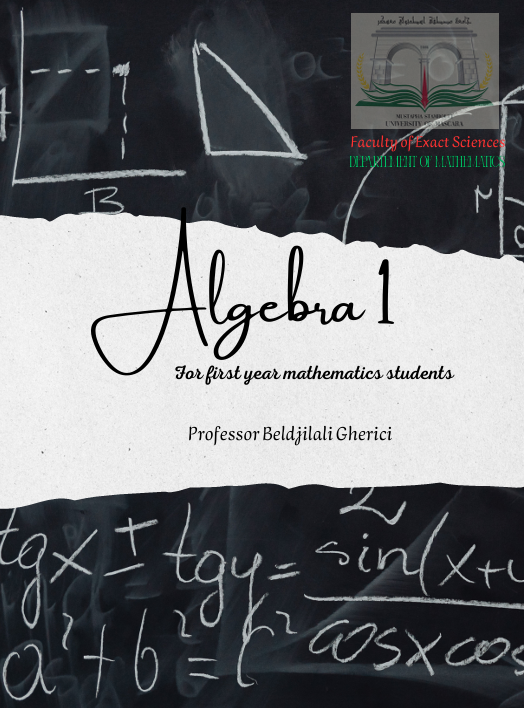
This first volume is devoted to algebra 1 and covers the algebra program of the first semester of the 1st academic year. It is mainly intended for 1st-year L.M.D. students as well as all persons in need of basic tools for linear algebra. We hope that this book meets the expectations of the students and that it will help them to succeed.
This document is divided into five parts. The first part begins with logic and the different types of mathematical proof. Then sets, which are fundamental in mathematics. In the third part, we will study the binary relations between sets, then algebraic structures, and finally polynomials. A large and varied collection of solved and unsolved examples and exercises can be found at the end of each chapter.
- Teacher: BELDJILALI gherici
These lecture notes are intended for first-year students in Mathematics. The course provides a foundational understanding of Information Technology (IT) concepts, hardware, software, and
applications. It also introduces the principles of Open Source software and its key tools.
The content of this course is organized into two main chapters:
- Chapter 1 defines Information Technology, identify key hardware and software components, and understand common IT applications,
- Chapter 2 details the concept of Open Source software, its advantages and disadvantages, and identify common Open Source tools.
- Teacher: Mohammed ZAGANE
- Teacher: NORIA BIDI